
|
|
|
|
Echoes of the Past: A Historiographical and Cultural Inquiry into the Enduring Legacy of Medieval Assam through Religion, Identity and Social Institutions
Guptajit Pathak 1
1 Assistant
Professor, Department of History Kanya Mahavidyalaya, Geetanagar-781021,
Guwahati, Assam, India
|
|
|
ABSTRACT |
|
|
Medieval Assam's religious, social, and political changes are reflected in its cultural fabric, which has had a significant impact on the region's current identity. This essay examines how religion, identity, and social structures converged to influence the historical development of medieval Assam in order to provide a historiographical and cultural investigation of the region's lasting legacy. By combining historical texts, epigraphic evidence, ethnographic accounts, and secondary literature, the study takes a multidisciplinary approach to mapping the ways in which local tribal traditions and religious beliefs particularly Neo-Vaishnavism interacted with socio-political authority and community structures. In order to create a distinctively cultural consciousness, the analysis demonstrates a process of dynamic cultural synthesis that reshaped power dynamics and created community identities.1 The study
examines how cultural legacies are passed down, disputed, and rearticulated
throughout generations by placing these themes within a historical context.
By highlighting plurality, regionalism, and the agency of indigenous
communities in forming society structures, the study challenges rigid
interpretations history of Assam. Furthermore, this study challenges
postcolonial and colonial historiographies that frequently ignore vernacular
traditions. In the end, our investigation confirms that Assam's medieval era
had a crucial role in creating the historical memory that still shapes
identity today, in addition to laying the groundwork for the development of
religious and social conventions. |
|||
|
Received 08 June 2023 Accepted 29 July 2023 Published 31 August 2023 Corresponding Author Guptajit
Pathak, pathakguptajit19@gmail.com
DOI 10.29121/Shodhgyan.v1.i1.2023.66 Funding: This research
received no specific grant from any funding agency in the public, commercial,
or not-for-profit sectors. Copyright: © 2023 The
Author(s). This work is licensed under a Creative Commons
Attribution 4.0 International License. With the
license CC-BY, authors retain the copyright, allowing anyone to download,
reuse, re-print, modify, distribute, and/or copy their contribution. The work
must be properly attributed to its author.
|
|||
|
Keywords: Medieval
Assam, Religion, Cultural Legacy, Social Institutions, Identity,
Neo-Vaishnavism, Historiography, Indigenous Traditions |
|||



1. INTRODUCTION
A significant but little-known period in Indian history, medieval Assam saw the emergence of several cultural influences that still influence the region's character today. Because of its location between the Brahmaputra valley and the eastern Himalayas, Assam is a crossroads of Austroasiatic, Tibeto-Burman, and Indo-Aryan cultures. In medieval Assam, where power was negotiated not just through governmental authority but also through the religious and social realms, these overlapping layers of influence created a distinctive socio-political environment. By concentrating on three interconnected dimensions religion, identity, and social institutions this study aims to shed light on the complex processes that characterized this era.
The region's cultural ethos was redefined by the rise of religion, especially the Neo-Vaishnavite movement started by Srimanta Sankardeva in the 15th and 16th centuries. Although dynastic politics, such as those of the Ahoms or Kamarupa kings, are frequently highlighted in mainstream historiography, the ways in which social institutions and religious beliefs supported the transmission of cultural identity are frequently overlooked. By analyzing how religious movements shaped elite and subaltern identities and helped create a more inclusive Assamese society, this research adopts a critical stance. Crucially, the study also examines the ways in which historical narratives have recalled, mythologized, or marginalized these traditions. Pegu (2010)
The study argues that an interdisciplinary approach is necessary to gain a fuller understanding of medieval Assam, placing the historiographical gap within a larger debate on sub-national histories. The study uses historical, anthropological, and cultural analytical methods to try to bring back the voices of local reformers, religious leaders, and tribal communities people who are frequently left out of mainstream narratives. By doing this, it advances the larger goal of decolonizing Indian history and reaffirms the importance of regional narratives in comprehending India's past. Nath (2012)
2. Statement of the Research Problem
The study of how Assamese society was molded by cultural and religious institutions has long been neglected in favor of a preponderance of political dynasties, particularly the Ahoms, in the historiography of medieval Assam. The methods by which social institutions like the Sattras, Namghars, and kinship systems developed and aided in the construction of identity in pre-colonial Assam have hitherto received little scholarly attention. This neglect has led to an imperfect understanding of how cultural continuity, communal memory, and regional identity were historically formed
Furthermore, although religion in particular, the Neo-Vaishnavite movement has been recognized as a significant influence in Assamese society, little is known about how it interacts with indigenous customs, social stratification, and ethnic integration. Therefore, the necessity to examine how religion, identity, and social institutions all worked together to shape Assam's cultural legacy during the Middle Ages and how these factors are represented in contemporary Assamese identity and historiography constitutes the study challenge.
3. Review of Related Literature
1) Gait, E. A. (1906), provides 'A History of Assam', one of the first attempts to document the history of Assam. Despite being viewed as antiquated by modern standards and containing the prejudices of colonial historiography, historians nevertheless use Gait's work as a starting point. His use of early indigenous sources and British administrative records provides insight into how colonial narratives influenced how Assam's history was understood.
2) Bhuyan, S. K. (1957), 'Anglo-Assamese Relations' likewise discusses identity, but from the standpoint of colonial interactions. His writings provide background for how British policies changed established power dynamics and impacted Assam's political and religious development. Important original data is provided by Bhuyan's archive technique, particularly for comprehending trends in the 19th century.
3) Neog, M. (1980), 'Religious Faith and Social Reform in Assam' provides a thorough examination of Neo-Vaishnavism, a religious movement led by Srimanta Sankardeva, a saint or reformer. Neog looks into how this movement helped create an equal social order by overcoming strict Brahmanical caste systems. His research highlights the Sattras monastic establishments as facilitators of religious democratization and social cohesion. Particularly in the Assam's context, where religion served as a spiritual and sociopolitical force, the book is essential in establishing the connection between religion and social transformation.
4) Guha, A. (1983), "Little Nationalism Turned Chauvinist?" is a thought-provoking indictment of sub-nationalism. Guha examines how Assamese identity is constructed and how it occasionally shows up in politics that exclude people. His arguments start a critical conversation on how religious narratives and historical memory might be used for political purposes.
5) Barpujari, H. K. (1992), It chronologically and thematically summarizes medieval Assam in 'The Comprehensive History of Assam, Vol. 3'. Barpujari's thorough historical research puts the changes in social structures, political systems, and religious life in perspective. Because of its meticulous periodization and factual depth, his work continues to be a cornerstone of any historical study pertaining to the area.
6) Baruah, S. (1999), 'India Against Itself: Assam and the Politics of Nationality' presents Assamese identity from a political science point of view. He explores the post-colonial conflicts in the area over immigration, nationalism, and ethnic assertion. His research is especially pertinent to comprehending the use of religious and historical symbols in contemporary identity politics.
7) Misra, U. (2000), 'The Periphery Strikes Back' adds to this discussion by exploring how the northeastern states have contested conventional Indian historiography. He contends that local narratives, identities, and agency need to be re-centered because the history of the area has frequently been overlooked.
8) Saikia, Y. (2004), offers ‘A Sophisticated Perspective on the ways in which Historical Memory Functions in the Tai-Ahom Community’. Saikia provides insight into how ethnic identity is formed in the face of colonial and post-colonial upheavals by concentrating on oral histories, family histories, and cultural rites. Her approach, which combines historical research and ethnography, signals a change in the region's history toward memory studies.
9) Sharma, B. K. (2005), 'Medieval Assam: A Socio-Religious Study' offers a thorough analysis of the medieval era in Assam from a socio-religious perspective. In order to illustrate the cultural synthesis among diverse populations, such as Muslims, Hindus, and tribal people, his work includes case studies. According to Sharma, medieval Assam was a pluralistic place with a strong emphasis on religious tolerance and syncretism.
10) Dutta, A. (2009), continues this line of investigation in 'The Sattras and Cultural History of Assam', with a particular emphasis on the Sattras' institutional function. He looks at how they serve as hubs for socio-religious education and preserve traditions in literature, art, and performance. Dutta highlights how these establishments were not just places of worship but also significantly influenced Assamese identity and cultural continuity over many generations.
11) Pegu, N. (2010), 'Tribal Traditions in Assam' focuses on the belief systems of different indigenous tribes and how they have been gradually incorporated into the larger religious fabric of Assamese culture. Pegu's analysis shows how the region's spiritual variety was enhanced by tribal cosmologies, rituals, and oral traditions. His writing highlights the diversity of religious practice in Assam and questions homogenizing narratives.
12) Nath, D. (2012), 'Religion and Society in North East India' highlights the relationship between societal transformation and religious organizations. Nath offers a macro-sociological viewpoint on the region's change by examining the ways in which religious movements in Assam impacted gender roles, social mobility, and intercommunity relations.
4. Background of the Study
With little interaction with indigenous sources and an excessive focus on colonial administrative documents, Assam's historiography has frequently been disjointed. Crucial turning points in the medieval era, particularly from the 13th to the 18th centuries, include the emergence of the Ahom dynasty, the expansion of Neo-Vaishnavism, and the assimilation of tribal tribes into the political system. But there is still a dearth of academic research on the topic, which is biased toward political chronicles, leaving large gaps in our knowledge of the creation and maintenance of cultural legacies.
The study arose from the understanding that the religious and cultural movements of this time period shaped social hierarchies, gender relations, and communal identities in addition to spiritual activities. A dynamic yet stable cultural structure that warrants more in-depth scholarly investigation was produced by the interaction of changing religious doctrines with social institutions including the Namghars Vaishnavite communal prayer rooms, Sattras monastic centers, and kinship networks.
4.1. Objectives of the Study
The objectives of the study are-
1) To examine how religion, especially Neo-Vaishnavism, influenced medieval Assamese cultural and social structures.
2) To explore how various ethnic communities formed their identities during the Middle Ages.
3) To investigate the ways in which social organizations like tribal councils, Namghars, and Sattras served as conduits for cultural fusion.
4) To review historiographical trends and reevaluate the representation of medieval Assam in academic discourse.
4.2. Research Questions
1) What effects did Neo-Vaishnavism and other religious movements have on Assamese culture and society during the middle Ages?
2) How did societal structures throughout the middle Ages help to create a common Assamese identity?
3) How have various tribal and ethnic groups dealt with their religious and cultural identities in Assamese society at large?
4) How has contemporary historiography portrayed or misrepresented the legacy of medieval Assam?
5. Research Methodology
1) Primary
Sources
The historical and cultural fabric of medieval Assam is uncovered in this study mostly through primary sources. Inscriptions, copper plate gifts, royal decrees, temple records, and chronicles like the Buranjis the Ahom court chronicles are important materials that provide the framework for reconstructing social, religious, and political events. Fieldwork will also include visits to historical locations, temples, Satras, and archeological ruins in order to collect evidence of material and visual culture. Interviews with elders, traditional performers, Satradhikars, and other cultural heritage custodians will capture oral traditions, folklore, and communal memory that are kept through local narratives, rituals, and practices. These resources provide for a thorough investigation of the formation and ongoing significance of religion, identity, and social structures in modern Assamese society.
2) Secondary
Sources
In order to shape the historiographical framework and interpretive lens of this investigation, secondary materials are essential. The theoretical and comparative foundation for this study is provided by scholarly publications, peer-reviewed journal articles, and historical assessments that discuss the sociopolitical systems, religious changes, and cultural identity of medieval Assam. Furthermore, research on caste relations, identity formation, and South Asian religious movements provides a more comprehensive framework for placing Assam within pan-Indian historical patterns. In order to gain a deeper knowledge of changing institutions and traditions, the research also draws on interdisciplinary sources from cultural studies, sociology, and anthropology. These supplementary resources aid in contextualizing the examination of primary data in broader scholarly discussions.
3) Rationale
From the early Kamarupa dynasties to the Ahom dominance, Assam's medieval age marked a turning point in the sociopolitical and cultural development of the area. In addition to changing the spiritual environment, this study aims to investigate how religious movements specifically, Srimanta Sankardev's Neo-Vaishnavite reform were crucial in creating collective identities and reorganizing social institutions like the Satras and Namghars. These establishments played a crucial role in regulating communal affairs, disseminating morals, and establishing a unique, plural, and locally based Assamese identity. However, the intricate governance structures of the Ahom administration, such as the Paik system, demonstrate how statecraft and cultural assimilation worked together to bring various ethnic and tribal groupings under a comparatively stable sociopolitical order.
The study is crucial not just to expand our understanding of medieval Assam’s internal dynamics but also to investigate how its historical narratives have been formed and transmitted through time. Through a critical engagement with religious texts, vernacular literature, colonial historiography, and buranjis (Ahom chronicles), the research will reveal the multi-layered processes of institutional construction and identity formation. Furthermore, it will analyze how the echoes of these medieval legacies continue to impact present-day Assam’s cultural practices, community structures, and political discourses. By providing a comprehensive and historically informed explanation of how religion, identity, and institutions converged to build long-lasting cultural frameworks in the area, the study seeks to fill gaps in the body of previous scholarship.
6. Results and Discussions
1) Neo-Vaishnavism's
Contribution to Cultural Change
In addition to being a theological awakening, Srimanta Sankardeva's Neo-Vaishnavite movement in the 15th and 16th century served as a foundation for a significant cultural transformation in Assam. It placed an emphasis on equality, good behavior, and devotion bhakti while rejecting many of the strict Brahmanical customs, including as ceremonial sacrifices and caste divisions. The movement democratized religious and artistic expression beyond the elite by introducing new creative forms, such as Borgeet devotional hymns and Ankiya Naat one-act dramas, which were predominantly composed in the vernacular of Assam. Sankardeva spread an approachable, memorable, expressive, and community cultural vernacular through various media. The construction and growth of Sattras monastic institutions and Namghars prayer halls offered institutional structures for the teaching, preservation, and reproduction of music, literature, and performance. According to scholars, the Sattra culture developed into a hub for literary creativity and creative expression, promoting Assam's as a literary standard, linguistic unification, and religious devotion. Misra (2000)
Sattras also functioned as social reformers, educators, and guardians of moral behavior in addition to being places of worship. Particularly in rural regions, Sattras emerged as the main educational establishment, offering instruction in scripture, ethics, the arts, music, and dance. By conserving manuscripts, fostering oral traditions, and educating craftspeople, theater (bhaona), and dance (later Sattriya), these monastic institutions also helped to maintain cultural continuity. They were essential to the generational continuation of Assam's performance customs. As these establishments expanded regionally, they strengthened a common culture among various populations. Therefore, the spread of the Neo-Vaishnavite idiom aided in the development of a unified Assamese cultural identity based on common religious, linguistic, and artistic traditions as well as social reform by reducing caste rigidity and promoting moral equality.
2) Native
Customs and Syncretism
Neo-Vaishnavism and the native religious systems of Assam's tribes, such as the Bodo, Mishing, and Karbi, among others, led to a complicated syncretism rather than simple assimilation. Despite adopting some Vaishnavite devotional traditions, indigenous cultures often kept their local deities, rituals, and cosmology. For instance, tribal ritual experts continued to worship nature deities or ancestor spirits while occasionally taking part in Naam-prasanga, or recitations of Krishna's names. The outcome was a cultural model in Assam that let the Bhakti movement to coexist with, be adapted to, or include aspects of local belief systems. This syncretic style allowed indigenous communities to demonstrate their uniqueness in the greater Assamese social arena while also acting as a safeguard against religious uniformity. Saikia (2018)
In addition to its political and social ramifications, this mixing of traditions lessened the polarization that may have resulted from religious differences. Through common devotional rituals, festivals, and communal meetings, syncretism allowed several tribal, caste Hindu, and occasionally adjacent groups to discover points of agreement. People from many origins gathered at these common cultural events, such as festivals held by Sattra or Namghar performances, to socialize with one another. These exchanges eventually helped to create an Assam's sense of regional identity based on both Vaishnavite reforms and indigenous customs.
3) Sattra
and Namghar as Social Organizations
In medieval and early modern Assam, the Namghar and the Sattra developed into important hubs of communal life. Founded by Sankardeva's students, the Sattra served as educational, artistic, and social welfare hubs in addition to being religious monastic institutions. They prioritized spiritual merit over inherited caste status in their more horizontal internal administration, which was run by a Sattradhikar with the help of disciples. Namghars functioned as public meeting places and prayer rooms and were frequently expansions of Sattra's operations into villages. They developed into places where moral teaching, group meals, religious rites, and performances were incorporated into daily life. Together, these organizations gave lower caste groups, peasants, and tribal people’s spaces to engage in religious and cultural activities on an equal basis. Vijayakumar (2022)
Additionally, these organizations had a part in local administration and conflict settlement. The Namghar served as a proto-panchayat in several areas, where the villagers used it to plan social welfare activities, discuss and resolve disputes, and make decisions as a group. Moral standards, social expectations, and group identity were shaped by Sattra and Namghar as institutions of social cohesiveness. In terms of architecture, the similarity of elements like the Namghar, Manikut, Karapat, and rows of disciple huts throughout regions represented a common cultural model, strengthening unity.
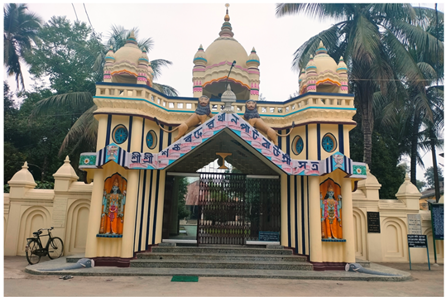
Figure 1
|
Figure 1 Main Gate of Sankardev Than, Patbausi Sattra, Barpeta Courtesy: Author
Guptajit Pathak |
Figure 1 A symbolic link between Srimanta Sankardeva's spiritual legacy and the material world is provided by Sankardev's Than Patbausi Sattra in Barpeta. The gate's straightforward and solemn form subtly blends elements influenced by Vaishnavite philosophy with native Assam's architectural features like sloping roofs and wooden carvings. It is more than just a gateway; it marks the beginning of a sacred journey into a location that was once a center of commitment, change, and artistic genius. Entering the gate marks the beginning of a peaceful continuum that skillfully blends the timeless teachings of Sankardeva with the daily rhythms of Sattra life.
6.1. Participation in Religion and Gender
Women have found relevant spaces within the Neo-Vaishnavite religious and cultural world, despite the fact that Sattra institutions have historically had male-dominated leadership and frequently limited female authority. According to Majuli ethnographic research, women weave traditional textiles, take part in religious performances, participate in Namghar rites, and are essential to the oral tradition and folk song transmission. These actions demonstrate that cultural and spiritual domains provide alternate channels of influence even in situations when formal institutional power is limited. Women's participation in folk performances, devotional meetings, and Borgeet singing helps to maintain the devotional culture and genderedly define its features.
Though within bounds, gender inclusion was made possible by Neo-Vaishnavism's focus on devotion above birth status and equality before God. Sincere dedication and moral behavior are more important than birth, according to the movement's teachings and practices. This subtly allows everyone, even women, to strive for spiritual dignity. But in reality, there were restrictions: women were frequently denied leadership positions in Sattra administration, formal priestly positions, or specific ceremonial rights that were only granted to male devotees. Nath (2020)
6.2. Gaps and Historiographical Representation
Many works of mainstream Indian historiography, particularly those from the earlier colonial and early post-colonial periods, viewed Assam as peripheral, emphasizing its political struggles, rulers, and administrative history over its religious establishments, vernacular literature, cultural customs, or indigenous voices. Colonial historians, for instance, frequently focused on the military operations of the Ahom kings or British administrative documents, paying less attention to the Sattra's influence on popular culture, religious reform, or intercommunal relations. Bora (2018) As a result, these narratives underexamined important facets of Assamese society, such as how Sattras and Namghars promoted gendered religious expression, allowed indigenous agency, or moderated caste inequity.
There has been a change in the last several decades. By retrieving oral histories, regional customs, and practices outside of written archives, subaltern history, memory studies, and ethnographic work such as fieldwork among tribal and peasant communities have started to close the gaps. These more recent studies raise voices that were previously overlooked or silenced, including those of women, lower caste devotees, and tribal people. However, there are still few comprehensive archival records available for some eras, especially the early medieval era, and many regional customs are still unrecorded, particularly as industrialization threatens to eradicate them.
6.3. Political Integration and Ethnic Identity
While retaining their unique local identities, ethnic groups in medieval Assam frequently interacted with the governmental systems of the day, such as the Ahom monarchy, by embracing common cultural customs. Despite their Tai ancestry, the Ahom kings incorporated numerous regional customs and religious practices and used the Assamese language for administration. This strategy helped to create a more cohesive regional polity rather than erasing ethnic differences. An emerging Assamese identity that went beyond more limited ethnic borders was facilitated by the Ahom-sponsored adoption of Assamese as the state language and the promotion of religious organizations like as Neo-Vaishnavism. Dutta (2017)
This legacy has political importance in the present era. Language rights, cultural preservation, and communal belonging movements frequently draw on Neo-Vaishnavism's heritage and the inclusion of Sattra and Namghar institutions. In spite of ethnic groups' claims to uniqueness, they represent togetherness. The historical foundation for the political mobilization of identity, especially during the colonial and postcolonial eras, is the number of communities that contemplate assimilating into Assamese culture while retaining their independence in ritual, language, or social structure.
6.4. Memory of the Past and Oral Traditions
Alternative memories that contradict, elucidate, or add to documented histories have been maintained through oral traditions including folktales, epics, genealogy, and performance narratives. Such customs in Assam frequently honor local heroes, saints, reformers, or even anonymous community members who have contributed to upholding customs, promoting social cohesiveness, or opposing injustice. These customs are carried down through the generations and are carried out in communal contexts, such as during festivals and Namghars. Instead of relying on court documents, they provide a form of grassroots historiography grounded in lived experience. Rahman (2015)
Additionally, these oral recollections function as active forms of resistance and identity in addition to being sentimental or cultural objects. They can be enlisted in current cultural or political conflicts over recognition, heritage, or territory. Additionally, they contribute to continuity by ensuring that the voices of common people are preserved in the event that written texts are lost or when official archives favor elite viewpoints. Scholars have occasionally discovered differences between official chronicles and local narratives; resolving these differences helps one comprehend identity, memory, and power.
6.5. Cultural Persistence and Current Significance
Many of the customs and establishments that date back to the Neo-Vaishnavite era of the Middle Ages still influence politics, identity, and history today. Originating in Sattra ceremonial performance, the Sattriya dance has been recognized as a traditional dance form in India. Namghars continue to act as centers for communal worship, cultural festivals, language use, and local governance in many villages. These continuities show how organizations established centuries ago are still flexible, strong, and applicable today. Bora (2018)
Neo-Vaishnavism and its institutions are frequently brought up in discussions about identity, tourism, historical preservation, and cultural commodification in the modern era. Namghars serve as platforms for community voice, while Sattras draw pilgrims and tourists. Both opportunities and challenges have been identified by scholars: the possibility that governmental patronage or tourism could commercialize religious traditions, or that contemporary sectarian divides could weaken the inclusive culture of bygone eras. However, the movement's lasting significance is demonstrated by the persistence of religious, cultural, linguistic, and artistic traditions not just as artifacts, but also as sources of moral guidance, cultural expression, and a sense of community.
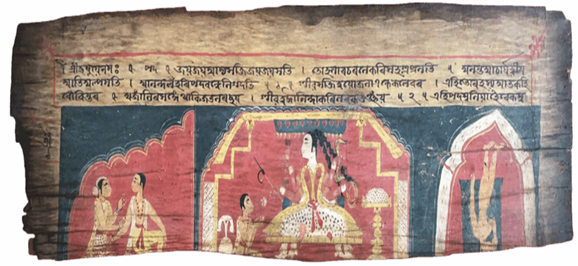
Figure 2
|
Figure 2 A manuscript recto Illustrating a Devotee Worshipping Ardhanarishvara Courtesy: Image
sourced from an Internet collection |
Figure 2 In this manuscript recto, a devotee is seen in awe of Ardhanarishvara, the god who symbolizes the unity of good and evil and is a hybrid of Shiva and Parvati. The artwork, which was extracted from an online collection, is a good example of the intricate detail present in early devotional texts, where spiritual narrative and visual symbolism coexist. The intensity of bhakti (devotion) is emphasized by showing the devotee in a position of humility and submission. In addition to capturing Ardhanarishvara's theological intricacy, this image shows how the manuscript tradition may successfully convey complicated philosophical ideas in visually understandable shapes.
Table 1
|
Table 1 Important Aspects of the Durable Legacy of Medieval Assam via Religion, Identity, and Social Institutions |
|||
|
Thematic Focus |
Key Historical
Insights |
Institutional Impact |
Contemporary Relevance |
|
Movement for
Neo-Vaishnavism |
Srimanta Sankardeva
started the socio-religious reform movement. |
Namghars and Sattras
were established as community-based religious centers. |
Influences
contemporary Assamese society's artistic, ethical, and spiritual traditions. |
|
Namghars and Sattras |
Multipurpose
establishments that integrated governance, education, and religion |
Democratized
understanding of culture and religious authority |
Continue to serve as
hubs for social discourse and cultural preservation. |
|
Indigenous and Tribal
Influence |
Native traditions were
incorporated into Vaishnavite rituals. |
Promoted a
multicultural sense of self |
Strengthens regional
and ethnic awareness of inclusivity in Assam |
|
Gender and the
Tradition of Bhakti |
Through oral
traditions and rituals, women's responsibilities were limited yet
participatory. |
Women have a small but
important spiritual space. |
Encourages continuous
gender discussion in cultural and religious contexts |
|
Memory and
Historiography |
Assam's contributions
were downplayed in colonial and nationalist historiographies. |
Historical archives
were provided by oral histories and performance arts. |
Promotes the
reexamination of local history using interdisciplinary approaches. |
|
Integration of Ethnic
Groups under Ahoms |
The harmonious
coexistence of various ethnic groups and religions was encouraged by the Ahom
government. |
Encouraged inclusive,
adaptable religious and administrative structures |
Serves as a historical
point of reference for current attempts at ethnic peace |
|
Culture and
Performative Arts |
Religious patronage
allowed devotional music, Bhaona, and Ankiya Naat to develop. |
Acted as channels for
the spread of culture and moral instruction. |
Keeps inspiring
projects in the fields of literature, theater, and education. |
|
Education and Literacy
in Institutions |
The Sattras cultivated
intellectuals and artists, taught scriptures, and maintained manuscripts. |
Developed an
unofficial system of moral and religious education |
The foundation of
heritage education and cultural literacy. |
|
Colonial Deception |
Colonial texts
frequently portrayed Assam as remote and archaic. |
The
underrepresentation of cultural complexity was systemic. |
Fuels regional
historical reclamation and decolonial scholarship |
|
Contemporary
Re-engagement in Academics |
The medieval history
of Assam has been reexamined by recent multidisciplinary research. |
In the fields of
cultural history, anthropology, and gender studies, new narratives are being
developed. |
Revitalizes policy and
public interest in cultural heritage |
7. Major Findings of the Study
The major findings of the study are-
1) The Neo-Vaishnavite movement in Assam was a revolutionary force that promoted egalitarianism, dedication, and cultural solidarity while also redefining religious traditions and laying the groundwork for extensive social transformation.
2) Beyond their religious aspects, the Sattras and Namghars developed into vibrant community hubs that institutionalized a distinctive kind of grassroots administration by carrying out judicial, educational, and cultural functions.
3) By incorporating tribal cosmologies, rites, and aesthetics, indigenous people helped to shape Vaishnavism and created a highly syncretic regional tradition that cut across strict sectarian boundaries.
4) Religious institutions supported decentralized authority, in contrast to centralized Brahmanical structures, where local leadership, community decision-making, and laity participation became defining characteristics of spiritual and cultural life.
5) The Neo-Vaishnavite ethos created limited but important places for women's religious expression, devotional leadership, and cultural participation, despite the persistence of patriarchal restraints. These spaces are particularly evident in the roles of female devotees and home rituals.
6) The region's rich intellectual and institutional past was obscured by dominant colonial and postcolonial narratives that devalued Assam's distinctive cultural history and frequently portrayed it as peripheral or backward.
7) By integrating various ethnic groups and spiritual traditions into a common cultural-political framework, the Ahom dynasty promoted pluralistic cohabitation in contrast to forceful homogenization.
8) Oral histories such as ballads, folklore, and ritual storytelling preserved complex accounts of socio-religious life in the absence of comprehensive written records, providing insightful counter-narratives to official history.
9) In both rural and urban settings, Sattras and Namghars serve as strongholds of moral authority, cultural transmission, and community mobilization, all of which continue to shape modern Assamese identity.
10) By accepting converts from lower castes and indigenous backgrounds, medieval religious and cultural institutions fostered communal unification and social inclusion by tearing down inflexible hierarchies.
11) Recent scholarly efforts have started to uncover buried narratives, rectify historiographical biases, and emphasize the intricacy of Assam's socio-religious development by utilizing anthropology, gender studies, and oral history.
12) Assam’s identity has historically developed as a multi-layered construct influenced by shifting boundaries between caste, tribe, language, and area, mediated through common ritual spaces, rather than a single ethno-religious category.
13) Sattras functioned as unofficial educational centers that maintained and passed along linguistic, aesthetic, and ethical knowledge to future generations through performance arts including bhaona, dance, music, and manuscript creation.
14) Vaishnavism has demonstrated resilience by modifying rituals, leadership styles, and outreach tactics while upholding its fundamental principles of inclusion and devotion in the face of external pressures from modernization and religious fanaticism.
8. Conclusion
A dynamic and profoundly ingrained process of civilizational synthesis is revealed when the cultural legacy of medieval Assam is examined via the intertwined frameworks of religion, identity, and social institutions. The Neo-Vaishnavite movement, which not only revived religious rituals but also reshaped the social structure of the area, was at the center of this heritage. It provided forums for moral education, artistic creation, and participatory government by promoting inclusive community places such as the Namghar and Sattra. By integrating caste-based and tribal communities into a common cultural discourse, these organizations arose as egalitarian alternatives to Brahmanical systems. Neo-Vaishnavism in Assam promoted a socially inclusive and morally based conception of devotion, in contrast to many other movements of the same era in South Asia. Dutta (2017)
Furthermore, by acknowledging the contributions of women as keepers of oral traditions, cultural rites and domestic religiosity, this movement subtly questioned conventional gender norms. Although there was still a lot of female asceticism, historical chronicles frequently fail to acknowledge that women were not completely shut out of the spiritual life. Furthermore, alternative historical narratives that challenged colonial distortions and pan-Indian generalizations were retained by the region's oral traditions, performance arts, and vernacular literature. The identity is still alive because to these imaginative forms of cultural memory, which serve as a reminder that religion in this setting served as a forum for moral and intellectual discussion rather than as a means of sectarian consolidation.
In particular, interdisciplinary approaches are being used
in contemporary re-readings of Assam's medieval past to assist retrieve these
complex legacies. By starting to question the erasures imposed by colonial and
nationalist historiography, scholars are bringing Assam's distinct trajectory
of pluralism, tolerance, and decentralized cultural development back into the
public eye. The Neo-Vaishnavite era's institutions and beliefs are still
significant today, not just because of their ritualistic continuity but also
because of their function as forums for discussion, defiance, and communal
harmony. The paradigm of religious tolerance and institutional tenacity stands
as a testament to the timeless influence of culture in forming social cohesion
and identity in an increasingly polarized sociopolitical environment. Neog (1980)
CONFLICT OF INTERESTS
None.
ACKNOWLEDGMENTS
None.
REFERENCES
Bora, S. (2018). Gendered Devotion in Neo‑Vaishnavism: Women, Monks and Sattras of Majuli, Assam. Indian Journal of Gender Studies, 25(3), 331-350. https://doi.org/10.1177/0971521518785665
Dutta, A. (2009). The Sattras and Cultural History of Assam. Gauhati University.
Dutta, A. (2017). Role of the state and Traditional Institutions in Identity Formation:
A Study of the Namghar in Assam. Journal of North East India Studies, 7(2),
15-30.
Misra, U. (2000). The periphery Strikes Back: Challenges to the Nation-State in Assam
and Nagaland (120-145). Indian Institute of Advanced Study.
Nath, D. (2012). Religion and Society in North East India. DVS Publishers.
Nath, J. (2020). Importance of Auniati Sattra in the Sattra Culture of Assam: A Brief
Overview. PalArch's Journal of Archaeology of Egypt/Egyptology, 17(7),
10709-10719.
Neog, M. (1980). Religion and Society in Assam: A Historical Survey (97-110). Gauhati University Press.
Neog, M. (1980).
Religious Faith and Social Reform in Assam. Gauhati University Press.
Pegu, N. (2010). Tribal Traditions in Assam. N.L. Publications.
Rahman, M. S. (2015). Role of Satra & Namghar in the Evolution of Genesis of Assamese identity. International Journal of Social Sciences and Management, 2(2), 108-113. https://doi.org/10.3126/ijssm.v2i2.12143
Saikia, B. (2018). An Introduction to the Sattra Culture of Assam: Belief, Change in Tradition and Current Entanglement. Journal of Ethnology and Folkloristics, 12(N), 2. https://doi.org/10.2478/jef-2018-0009
Vijayakumar, B. (2022). The Origin of Neo‑Vaishnavism and the Role of Sattra in the Development of Arts and Literature of Assam. International Research Journal of Tamil, 5(1), 152-159. https://doi.org/10.34293/tamil.v8i1.6279
|
|
 This work is licensed under a: Creative Commons Attribution 4.0 International License
© ShodhGyan 2023. All Rights Reserved.